ChatGPT Ads Are Coming: What OpenAI Announced, How It Works, and What It Means for the Future of Advertising
Meta description: OpenAI is testing ads inside ChatGPT for Free and Go users in the U.S. Here's what it is, how it works, why OpenAI's doing it, and how brands should prepare.
At the end of the day, this was always going to happen.
When a product becomes the place people go to think, plan, shop, and decide—someone eventually asks the obvious question: "How do we pay for this at scale?"
That's where we are with ChatGPT ads. OpenAI has confirmed it's preparing to test advertisements inside ChatGPT in the U.S. in the coming weeks. Not rumors. Not a leak. It's an explicit rollout plan with stated principles and guardrails. (OpenAI)
And so, if you're a founder, marketer, or operator trying to understand what this changes for Google Search ads, YouTube, Instagram, TikTok, and the broader digital ad market—this is your reality check.
I'll break it down in plain language, with receipts, and a practical "what to do next" plan.
(And yes—this is written in my usual cadence: clear, direct, and focused on what matters. )
1) The announcement: what ChatGPT ads are, and who will see them
What it is: OpenAI plans to begin testing ads inside ChatGPT. These aren't ads "baked into" the AI's answer. They're designed to appear in a separate, clearly labeled sponsored section. (OpenAI)
Who will see it (initially):
- Logged-in adults in the United States
- On ChatGPT Free
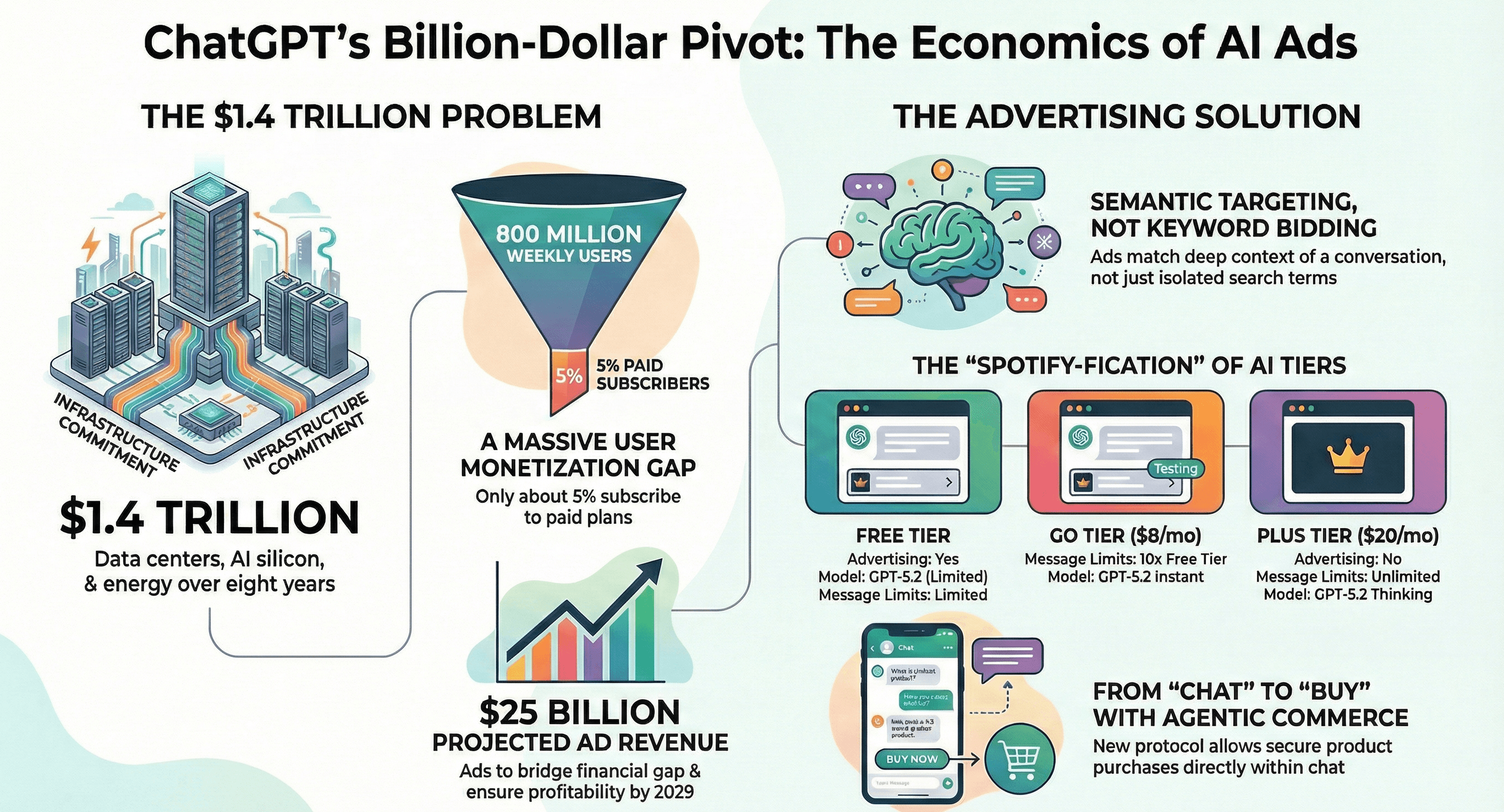
- And on the ChatGPT Go plan (priced at $8/month) (OpenAI)
Who won't see it (based on current statements):
- Higher tiers like Plus, Pro, Business, and Enterprise are intended to stay ad-free. (OpenAI)
Where ads will show up: OpenAI says it plans to test ads "at the bottom of answers"—again, in a separate area from the response itself. (OpenAI)
OpenAI is also explicit that ads aren't fully "launched" yet—it's a test starting "in the coming weeks." (OpenAI)
2) The mechanics: how ChatGPT ads work (high-level, technical, and actually useful)
Here's the thing: OpenAI is drawing a bright line between the AI answer and the sponsored placement.
They call it "Answer independence." In their own words:
"Ads do not influence the answers ChatGPT gives you." (OpenAI)
That statement is the foundation. Everything else is implementation.
The simplest mental model (what's happening under the hood)
Think of ChatGPT ads as two parallel systems:
- The response system (the model answers your question)
- The ad system (a matching/ranking layer decides whether to show a sponsored product/service)
OpenAI's described behavior looks like this:
- You ask something (ex: "Help me plan a weekend in NYC.")
- ChatGPT gives the organic response
- If there's a relevant sponsored option, an ad may show below the answer in a labeled box (WIRED)
What triggers an ad
OpenAI's stated trigger is contextual relevance:
"We plan to test ads at the bottom of answers… when there's a relevant sponsored product or service based on your current conversation." (OpenAI)
The Verge frames the first wave as "sponsored products or services" related to your conversation, and describes it as starting with shopping-style links. (The Verge)
How targeting works (contextual + limited personalization)
This is the nuance most people miss: OpenAI says ads won't influence answers—but conversations can influence ads.
WIRED reports OpenAI will match conversation topics to ads, with some personalization data potentially used—while also saying users can turn off the data used for advertising. (WIRED)
OpenAI's "Choice and control" principle is pretty direct:
"You can turn off personalization, and you can clear the data used for ads at any time." (OpenAI)
Privacy and data sharing (OpenAI's stated stance)
OpenAI is staking the brand on privacy language that's unusually blunt for ad tech:
"We keep your conversations with ChatGPT private from advertisers, and we never sell your data to advertisers." (OpenAI)
WIRED adds that advertisers would see aggregate ad performance metrics (like impressions/clicks), not your individual conversation details. (WIRED)
Brand safety: sensitive topics and minors
OpenAI says ads won't be eligible:
- if the user is under 18 (including an age-prediction approach)
- near "sensitive or regulated topics" like health, mental health, or politics (OpenAI)
The "interactive ads" direction (this is where it gets interesting)
OpenAI is hinting this won't stay "banner-like" for long.
They describe a future where an ad becomes something you can question inside the chat:
"Soon you might see an ad and be able to directly ask the questions you need to make a purchase decision." (OpenAI)
That line matters, because it implies a new format: conversational commerce ads—where the ad is the start of a guided buying experience, not just a click-out.
3) The business logic: why OpenAI is doing this now (and why it looks like social media's evolution)
Let's be real—OpenAI didn't wake up and suddenly "feel like" building an ad business.
They're dealing with two realities at the same time:
Reality #1: ChatGPT is enormous, and most users don't pay
Multiple reports cite 800+ million weekly active users, with the majority not paying. (Reuters)
That's a massive audience with massive compute cost.
Reality #2: The infrastructure bill is not cute
Reuters reports OpenAI plans to spend more than $1 trillion on AI infrastructure by 2030 (and also notes the company has not detailed how it will fund it). (Reuters)
AP describes the company as still operating at a loss and under pressure to turn that scale into sustainable revenue. (AP News)
Reality #3: Ads subsidize access—and that's the public narrative
OpenAI is tying ads to "expanding access" and reducing usage limits for people who can't or won't pay.
"We've been working to make powerful AI accessible… through our free product and low-cost subscription tier… In the coming weeks, we're also planning to start testing ads…" (OpenAI)
This is the same macro arc we saw with social platforms:
- Launch with a clean experience
- Grow distribution like crazy
- Eventually monetize attention and intent
The difference is OpenAI is trying to get ahead of the "social media playbook" criticism with a stated principle that's basically a shot across the bow:
"We do not optimize for time spent in ChatGPT. We prioritize user trust and user experience over revenue." (OpenAI)
Will they hold that line long-term? We'll see. But that's the stated posture.
4) The impact: what ChatGPT ads change for OpenAI, Google, YouTube, Instagram, TikTok, and the ad market
Impact on OpenAI: a new revenue engine that doesn't require everyone to pay
This is straightforward:
- Subscriptions (Plus/Pro/Business) are strong revenue lanes
- But ads monetize the massive Free/Go population
- That "long tail" is where the money is when you're at 800M weekly users (Reuters)
Reuters summarizes the strategic shift: ads are a "major departure" from the subscription-only approach—and a push to generate revenue for high costs. (Reuters)
Impact on user behavior: ads show up at the moment of intent
This is the part advertisers are quietly excited about.
ChatGPT isn't a feed. It's not doomscrolling inventory.
It's "I need to choose." It's "Help me decide." It's "What should I buy?"
That's high-intent territory.
Search Engine Land frames it plainly: ChatGPT ads could give advertisers a "high-intent" way to reach users inside relevant conversations. (Search Engine Land)
Impact on Google Search ads: real competition at the decision layer
Google has dominated intent for two decades because Search = demand capture.
ChatGPT threatens a slice of that by changing the interface:
- From "10 blue links + ads"
- To "one synthesized answer + a decision path + sponsored options"
Even before ChatGPT ads, analysts noted the lack of ads in ChatGPT helped drive early usage compared to traditional search experiences. (EMARKETER)
Now here's the twist: Google is already threading ads into AI-powered search features—but is cautious about ads in its assistant app.
Business Insider reports Google's ads leadership has said there are no plans to put ads into the Gemini app "yet," while focusing monetization in AI search experiences (where commercial intent is clearer). (Business Insider)
That should tell you something: intent is the battleground, and chat interfaces make monetization tricky because trust is fragile.
Impact on YouTube ads: less direct, but budgets may shift
YouTube is still king for:
- reach
- storytelling
- demand generation
But ChatGPT ads can compete for the "I'm ready to buy" moment. If conversion rates in ChatGPT placements outperform, performance marketers will rebalance budgets. That doesn't "kill YouTube"—it changes the mix.
The key is funnel position:
- YouTube / TikTok / Instagram: awareness + consideration
- Search + retail media: conversion capture
- ChatGPT (with ads): potentially consideration + conversion in one flow
Impact on Instagram and TikTok: discovery vs decision
Social is still unmatched for discovery. But discovery is noisy.
ChatGPT is different: users give context willingly. They ask for filtering. They ask for tradeoffs. They ask for recommendations.
If OpenAI's ad experience becomes "sponsored, but genuinely helpful," you should expect:
- some lower-funnel spend to move into ChatGPT tests
- pressure on other channels to prove incrementality
I'm not going to promise "CPMs will drop everywhere." Markets don't move that neatly. But I am saying a new high-intent placement can change the pricing power of existing inventory over time.
Impact on trust: the risk is real, and the quotes are blunt
Reuters includes a warning that's worth printing and taping to your monitor:
"If ads feel clumsy or opportunistic, users can easily switch…" (Reuters)
AP includes the civil society / digital rights angle too—concern that personalized ads push OpenAI down a familiar path:
Personalized ads start OpenAI "down a risky path." (AP News)
That's the trade: monetization vs trust. OpenAI knows it. That's why their principles read like a constitution.
5) What brands should do next: how to win in ChatGPT's ad era
If you're waiting for the "OpenAI Ads Manager" UI to show up before you act, you're late.
Because the brands that win early will do two things before the platform even matures:
- They'll be the best answer—sponsored or not
- They'll be ready to test fast once inventory opens
OpenAI even positions this as an opportunity for smaller players:
"Ads also can be transformative for small businesses and emerging brands trying to compete." (OpenAI)
Quick wins (you can start this week)
- Fix your product truth: pricing, shipping, guarantees, inventory clarity, return policies.
- Build "decision pages," not fluff pages: comparisons, FAQs, "who it's for," "who it's not for," proof, reviews.
- Write for conversation: your copy should answer the follow-up question someone will ask after the ad shows.
- Instrument measurement: you'll want clean attribution (UTMs, conversion APIs, post-purchase surveys).
The new creative standard: "helpful" beats "clever"
If ChatGPT ads become interactive, the best "creative" is:
- a clean offer
- a clear claim
- and a landing experience that continues the conversation without friction
OpenAI is explicitly aiming for ads that are useful and relevant, not spammy. (OpenAI)
Top pitfalls (how brands will waste money)
- Treating ChatGPT like banner inventory. It's not. This is intent + context.
- Over-indexing on targeting hacks. OpenAI's privacy stance limits classic surveillance-style targeting. (OpenAI)
- Sending traffic to generic homepages. In a conversation, specificity converts.
A practical 90-day plan for brands (how to lead instead of watch)
Give us 90 days—seriously.
Days 0–7: Baseline + prep
- Identify 3–5 "high intent" queries your buyers already have
- Build landing pages that answer those questions cleanly
- Set measurement standards (UTMs, events, conversion goals)
Days 8–30: Offer + funnel stress-test
- Create 2–3 ad-ready offers (trial, bundle, consultation, demo)
- Tighten proof (reviews, case studies, guarantees)
- Build follow-up flows (email/SMS/chat support)
Days 31–90: Scale what works
-
When ChatGPT ad inventory becomes accessible, test small budgets fast
-
Compare performance against Google Search and paid social on:
- conversion rate
- CAC
- time-to-decision
-
Double down only where it's incremental
If we don't hit the agreed metric, you walk—no hard feelings.
FAQ (for the questions everyone is asking)
Will ChatGPT have ads? OpenAI says it plans to test ads in the U.S. in the coming weeks, initially for Free and Go users. (OpenAI)
Will ChatGPT Plus/Pro have ads? OpenAI says Plus/Pro/Business/Enterprise subscriptions will not include ads (based on current plan). (OpenAI)
Will ads change ChatGPT answers? OpenAI's stated principle: "Ads do not influence the answers ChatGPT gives you." (OpenAI)
How are ChatGPT ads targeted? OpenAI says ads are based on the current conversation, with user controls to turn off personalization and clear ad-related data. (OpenAI)
Will OpenAI sell my data to advertisers? OpenAI says it will never sell your data to advertisers and will keep conversations private from advertisers. (OpenAI)
Closing thought
Here's my read: ChatGPT ads aren't just "another ad placement." They're a new kind of decision surface—one that sits between discovery (social/video) and conversion (search/retail).
If OpenAI pulls off "useful, clearly separated, privacy-respecting" sponsored placements, they unlock a serious revenue stream and they reshape how performance marketing works.
If they don't—if the ads feel awkward, intrusive, or manipulative—people will bounce. And the market will punish it fast. (Reuters)
If that sounds right, I'll map a 90-day pilot.
References and primary reporting used
- OpenAI's official announcement and ad principles (OpenAI)
- Reuters on rollout scope, revenue pressure, and analyst concerns (Reuters)
- WIRED on mechanics, privacy posture, and interactive ad direction (WIRED)
- The Verge on shopping-style sponsored placements and user controls (The Verge)
- AP on broader implications, trust concerns, and market context (AP News)